Gaurab Khadka Human Robot Interaction

Gaurab Khadka · Graduate researcher

GaurabKhadka

I build tools that let people without robotics expertise author the behavior of robot teams, where a model composes the plan and the person keeps the last word.

Position
M.S. Computer Science
University of Michigan Flint
Lab
PLAYLab
University of Michigan Flint
Fields
Human Robot Interaction
HCI · Human AI Interaction
Index
Curriculum Vitae
gaurabk@umich.edu
GitHub · LinkedIn
drag anywhere to author a path authored by a person executed by the fleet

02 What I study

One question, from four directions

I am a master’s student in Computer Science at the University of Michigan Flint, where I work in PLAYLab on end user authoring for human multi robot interaction. My thesis work grew out of a concrete failure in my earlier system: expressive robot behaviors had to be rebuilt by hand for every new scenario. So I built a system where novices author the motions, by sketching or by physical demonstration, and an LLM reuses that motion library across scenarios, with the person reviewing and editing the plan before any robot moves.

I care about the human side of that loop: what people can author, what they can read off a robot’s motion, and where they need to intervene when a model proposes something wrong. I also mentor an undergraduate researcher on accessible AR authoring through UM Flint’s NSF REU Site in Digital Accessibility. I am applying to PhD programs in HCI and HRI for Fall 2027 entry.

Hover an area to light its work · click a project to reorganise the field

Research interests

End user robot programming Human multi robot interaction Legible robot motion Human oversight of LLM generated robot behavior

Six areas meet in the same question: my thesis work and the motion study sit in HRI, expressive motion and multi robot systems, EventMakAR in authoring and interactive systems, and the nursing video work in human AI interaction.

03 Systems I have built & studied

Three systems, one question

Each answers a piece of the same problem: how does a person who is not a roboticist tell a team of robots what to do, and know what they are doing? Open a card for the problem, the system, my role, the method and the result.

Try it: the model proposes, you decide

plan proposed · awaiting your review

A miniature of the stance the system is built on: the robots do not move until a person approves the plan.

Problem

Expressive behaviors were hand engineered for one scenario and could not travel to another.

Method

Counterbalanced within subjects study comparing two ways of authoring, with think aloud, workload and usability measures, and interviews.

Status

Full paper under review. Described in general terms here while review runs.

System

Novices author the motions themselves, either by sketching the path they want or by demonstrating the motion physically. A language model composes those motions into a plan for a scenario described in plain English, and the person reviews and edits that plan before any robot moves.

My role

I built this end to end: the robots and their electronics, the localization and the control server that drives them, both authoring interfaces, and the planning and validation layer behind them. The interface work was as much of the problem as the hardware: it has to be usable by someone who has never programmed a robot, in one sitting, under observation. I designed, ran and analyzed the user study.
Full project page

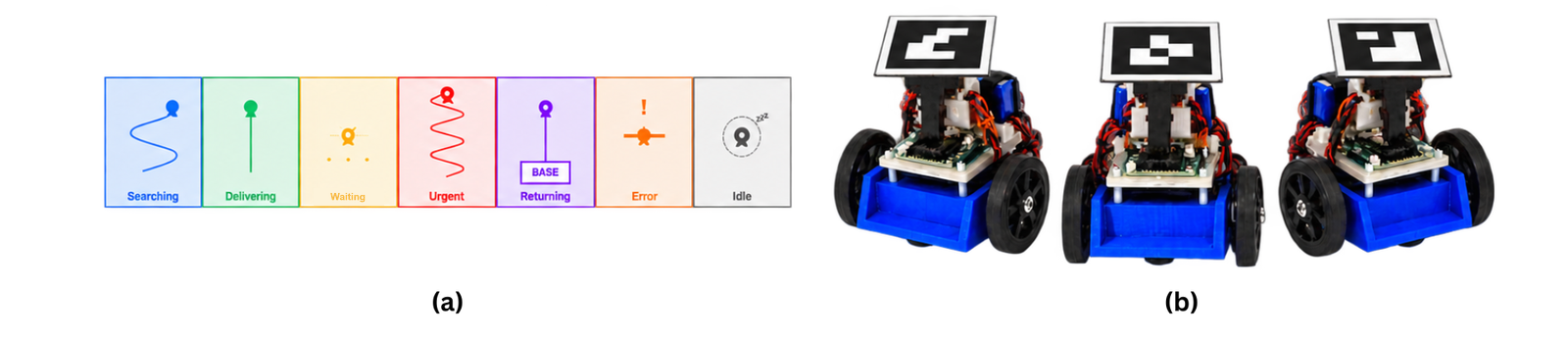
The vocabulary: pick a primitive to watch it run

Each primitive is a movement pattern meant to be read at a glance rather than decoded.

System

Three robots at about $30 each, seven motion primitives, camera based ArUco tracking.

Method

User study with 11 participants reporting what they believed each robot was doing.

Result

Motion alone carried the state (SUS ≈ 70), but two primitives collided and none of them travelled to a new scenario.

Left: the seven motion primitives drawn as colored path diagrams. Right: three photographs of the robots.
The seven primitives, and the fleet that performed them.

Why it matters

If a designer hand authoring behaviors can still pick two that people confuse, the fix is not a better designed vocabulary. It is letting the people who know the task author the motions themselves. That is what the thesis work does.

Full project page

Problem

Driving an AR experience with real robots normally needs a programmer in the loop, so the story decisions sit with whoever can edit the project.

System

A standalone browser tool: sequence actions across four virtual characters and eight physical devices, and it writes the exact events file the existing Unity runtime already parses.

Outcome

Deployed live at the Super Friday workshop at UM Flint, where students authored and ran their own AR stories with physical robots.

What this is and is not

A deployment, not a study: I did not collect measures at the workshop. Its value is as evidence that the authoring model survives contact with real users, and that I can ship a system other people use.

Full project page

04 Publications

Publications & manuscripts

Under review

On my thesis work. The paper title, the system and results figures, and video of the fleet are held back while the review process runs. The project page describes the work in general terms. I am glad to send figures and a demo to faculty who ask.

Project page   Request figures

In preparation

My contribution: I designed and built the AI assisted production pipeline (script generation written to the competency each video serves, image prompting, assembly, and delivery through the course’s LMS), and designed the “Evidence Elevator” device for teaching the hierarchy of evidence.

Project page

Nothing on this page is peer reviewed and accepted yet; status labels are updated as decisions arrive.

05 Background

Appointments

Graduate Student Research Assistant, PLAYLab

Aug 2025 – present

University of Michigan Flint

Design and build end user authoring tools for multi robot teams, and run the studies that evaluate them. That includes the hardware: I build the robot fleets themselves, their localization, and the control software that drives them.

Graduate Student Research Assistant (part time)

Jan 2026 – present

School of Nursing, University of Michigan Flint · PI: Dr. Beverly Dabney

Social web inspired video for nursing education. I designed and built the AI assisted production pipeline. Manuscript in preparation.

Research Mentor, NSF REU Site in Digital Accessibility

May – Jul 2026

University of Michigan Flint

Mentored an undergraduate researcher on an AR authoring tool that lets autistic users program robot and IoT behaviors through spatial storytelling and visual cues, and guided co design sessions with autistic participants.

Student Volunteer, ACM RecSys 2026

2026

Minneapolis, MN

Trajectory

Drag to spin · click a node
  1. Aug 2025Joined PLAYLab, University of Michigan Flint

    Started the M.S. in Computer Science and a graduate research assistantship. GPA 4.0 / 4.0, expected May 2027.

  2. 2025Expressive motion study: first fleet, first study

    Built a three robot fleet with seven motion primitives and ran a study with 11 participants. It worked, and it exposed the limitation that set up the thesis.

  3. 2025 – 2026EventMakAR deployed at a public workshop

    Students authored and ran their own AR stories with physical robots, the first time the authoring model met users outside the lab.

  4. Jan 2026School of Nursing assistantship

    Designed and built an AI assisted pipeline for short form educational video. Manuscript in preparation.

  5. May – Jul 2026Mentored an NSF REU researcher

    Accessible AR authoring for autistic users, including co design sessions with autistic participants.

  6. Sep 2026Full paper submitted for review

    Novices author the motions, a model composes the plan, the person approves before anything moves. Under review.

06 What I want to study next

Questions that came directly from my own projects

The systems I have built solved some problems, but they also showed me what I still do not understand. These are the questions I want to explore during a PhD.

Question 01

What can people really check before a robot acts?

In one of my recent projects, a model helps create a multi robot plan, but a person reviews and approves it before the robots move. I want to understand what people actually notice during that review, what kinds of mistakes they miss, and how interfaces can better support that decision.

Question 02

Will other people understand the motion?

In an earlier study, some robot motions that were designed to communicate different states were still confused by participants. That made me interested in how we can help people create robot motions that are understandable not only to the person who made them, but also to someone seeing them for the first time.

Question 03

How can robot authoring work for more people?

My current work explores sketching and physical demonstration as ways to create robot behavior. But people have different abilities, preferences, and ways of interacting. I want to study how robot authoring tools can be designed for that range from the beginning.

07 Contact

Get in touch

I am applying to PhD programs in HCI, HRI and human AI interaction for Fall 2027 entry, and I am glad to talk about end user robot programming, multi robot studies, or the hardware behind any of it.

Email
gaurabk@umich.edu
Location
Flint, Michigan, USA
CV
PDF
Elsewhere
GitHub · LinkedIn